At one o'clock on the afternoon of 27 October 2026, the Prime Minister of Thailand walked onto a stage at Government House, picked up a model solar panel, and set it on a model rooftop. The gesture was small. The offer behind it was not: 50,000 baht toward solar panels for 1 million Thai households, with registration opening the same day and running to 31 January 2027. If your electricity bill has been climbing and your roof gets good sun, this is the most generous home-solar offer Thailand has ever made — and the easiest one to lose through a avoidable mistake.
This guide covers the whole programme in plain language: the money, the eligibility rules, the registration steps, the loan, the surplus-power buy-back, every deadline, and the two trade-offs that change the answer for some households. Every figure comes from the cabinet approval and the MEA/PEA guidance reported on 27 October 2026, and where a figure comes from a bank or a vendor rather than the government, this guide says so.
What the People's Solar Project actually is
The People's Solar Project is a government programme, approved by the cabinet on 27 October 2026 and run by the Metropolitan Electricity Authority (MEA) and the Provincial Electricity Authority (PEA) under the Ministry of Interior, together with the Ministries of Finance, Energy and Labour. Its goal is practical rather than grand: help 1 million households generate their own electricity, cut their bills, and reduce the country's dependence on imported fuel at a time when energy prices have been driven up by war in the Middle East.
The core offer is a 50,000 baht support payment per household toward the equipment and installation cost of a home solar system. The total budget is 50 billion baht, which is exactly 50,000 baht times 1 million households — there is no hidden second pot. Registration opened on 27 October 2026 and closes on 31 January 2027, or earlier if all 1 million slots are taken. The programme is funded from the energy-transition part of a 400-billion-baht emergency borrowing package, and the cabinet also approved more than 20 billion baht of smart-grid investment so that households can sell surplus power back to the system.
The Prime Minister framed it at the launch as something larger than panels on roofs: turning roofs into energy producers, turning electricity expenses into family savings, and turning consumers into contributors to national power production. The government estimates the programme will cut household electricity costs by more than 24.5 billion baht a year and cut purchases from the grid by about 6,323 million units in the first year. Those are government estimates for the whole programme, not promises for any single home — your own saving depends on your system size, your daytime use, and your roof.
The money: 50,000 baht, and what it does not cover
The subsidy is a flat 50,000 baht per household, not a percentage of your system cost and not a payment per kilowatt. A 5-kilowatt system and a 10-kilowatt system both attract the same 50,000 baht. That matters when you choose a size: the subsidy covers a larger share of a smaller system, while a larger system saves more on bills but leaves you paying more of the difference yourself.
For a sense of scale, a vendor illustration circulating since the launch puts a 5-kilowatt system at about 140,000 baht: minus the 50,000 baht subsidy, the household pays 90,000 baht. That illustration is a vendor's example, not a government price — real quotes vary by roof, equipment and installer, and you should collect more than one. Use the calculator at the top of this page with your own quote: it subtracts the 50,000 baht and shows your net cost, your loan instalment if you borrow, and how many months of bill savings it takes to recover the net cost.
One more money fact that is easy to miss: the subsidy is paid after installation and grid connection, not before. If you pay cash, you pay the installer in full and are reimbursed to your PromptPay account once the connection succeeds. If you take a loan, the bank pays the installer and the government transfers the subsidy directly to the bank. Either way, you need the cash flow or the loan arranged before the panels go up — the subsidy does not pay your deposit.
Who qualifies — and the meter-name rule that decides most rejections
The published conditions are short, and each one is a hard filter. You must be a natural person holding Thai nationality. You must be a residential electricity user under category 1. Your name must be the same as the owner of the meter where the solar system is installed. The support can be used only once per person for the whole project. And the tax-exemption and welfare conditions below apply in full.
Two exclusions deserve emphasis because they surprise people. Temporary meters are excluded, and condominiums are excluded — the programme is for houses with their own meter, not for temporary supplies or condo units. If you bought a second-hand home, check the meter first: buyers of second-hand homes must make sure the meter is transferred into the correct owner name before registering, because the name-match rule is checked against the utility's own records, not against what you believe.
The name-match rule is the single most fixable reason applications fail, and it is fixable only before you register. If the meter is still in a previous owner's name, a parent's name, or a spouse's name that differs from yours, go to the electricity authority and change it first. Registering with a mismatched name and hoping the utility will sort it out later is the mistake to avoid.
There is one generous side to the rules: one entitlement applies per meter, not per person, so a person who owns several meters may register each home. A central database checks for duplication, so do not try to register the same meter twice — the check will catch it.
Registration step by step
Step one: check the five conditions above, including the meter name, and fix anything that fails before you touch the portal. Step two: register online at the People's Solar portal at peoplesolar.mea.or.th, or at a one-stop service point at your electricity authority, where participating banks also serve customers. Identity verification runs through the ThaiD application, or in person at the local authority office.
Step three: after registration, an accredited vendor inspects your site for technical suitability — roof strength, sunlight orientation, shading — and confirms whether the planned system can actually be installed. About 400 vendors accredited by the utilities do these inspections, and surveys are due to be completed by 30 June 2027. Step four: choose your installer from the registered route, sign the contract, and make sure your tax invoices are dated from 27 October 2026 onward. An earlier invoice does not count, even if the equipment is identical.
Step five: installation by MEA, PEA or a registered vendor, with at least panels and an inverter. Step six: request connection to the MEA or PEA grid — through the MEA MyEnergy system or the PEA PPIM system — by 31 August 2027, and complete the connection by 30 September 2027. Step seven: the subsidy is paid by 31 December 2027 if every condition is met. Keep every document at every step: ID, meter details, contract, invoices, meter serial number, and dated installation photographs.
The loan: 2.5 percent, 7 years, no credit-bureau check
If you cannot pay the balance after the subsidy in cash, three state banks will lend it: the Government Savings Bank, the Government Housing Bank (GH Bank), and the Bank for Agriculture and Agricultural Cooperatives (BAAC). The reported terms are a uniform 2.5 percent a year over 7 years, with the solar system itself as collateral, instalments collected through your electricity bill, and no credit-bureau check. During the repayment period the banks also guarantee the systems and provide panel-cleaning services to keep generation up.
The arithmetic is worth doing before you sign. Take the vendor illustration of a 140,000 baht system: after the 50,000 baht subsidy, 90,000 baht remains. Over 7 years at 2.5 percent, that is roughly 1,170 baht a month by the standard annuity calculation — close to the vendor's own illustration of about 1,236 baht a month at 2.2 percent on a slightly different basis. Your actual instalment depends on your quote, your bank, and the final loan terms, so treat any figure here as an estimate and confirm the bank's own schedule before signing.
The reported benefit figures need the same care. The Nation reports monthly savings of approximately 1,100 baht once the seven-year loan is repaid and the household keeps the full benefit for the panels' remaining life of around 13 years, on a 20-year lifespan. The Finance Minister has separately described a net income of roughly 700 to 1,000 baht a month during repayment, after loan instalments are deducted from electricity-sales income. Both figures are reported estimates, not guarantees: generation depends on weather and sunlight, and no exact output can be guaranteed.
Selling surplus power: 2.20 baht, and why self-use pays better
Surplus electricity sells back to the grid at 2.20 baht per unit, under a 20-year arrangement. The buy-back covers up to 5 kilowatts even if your system is larger: a 10-kilowatt system still only sells back from 5 kilowatts, so the extra capacity is worth it only if your home uses that power itself. The utility will swap your meter for a free smart meter as part of the process.
The design lesson is simple and worth more than any subsidy figure: a unit you use yourself is worth roughly twice a unit you sell back, because self-used power replaces electricity bought at the retail tariff of roughly 4 to 5 baht per unit, while exported power earns only 2.20 baht. Homes that use a lot of electricity during daylight hours — someone at home, a home office, a shop, daytime appliances — recover their cost fastest. The ministry has said homes with bills of about 3,000 to 4,000 baht a month benefit most. If your home is empty all day and your bill is small, size the system for your real daytime use and ask your vendor to show you the self-use maths, not just the panel count.
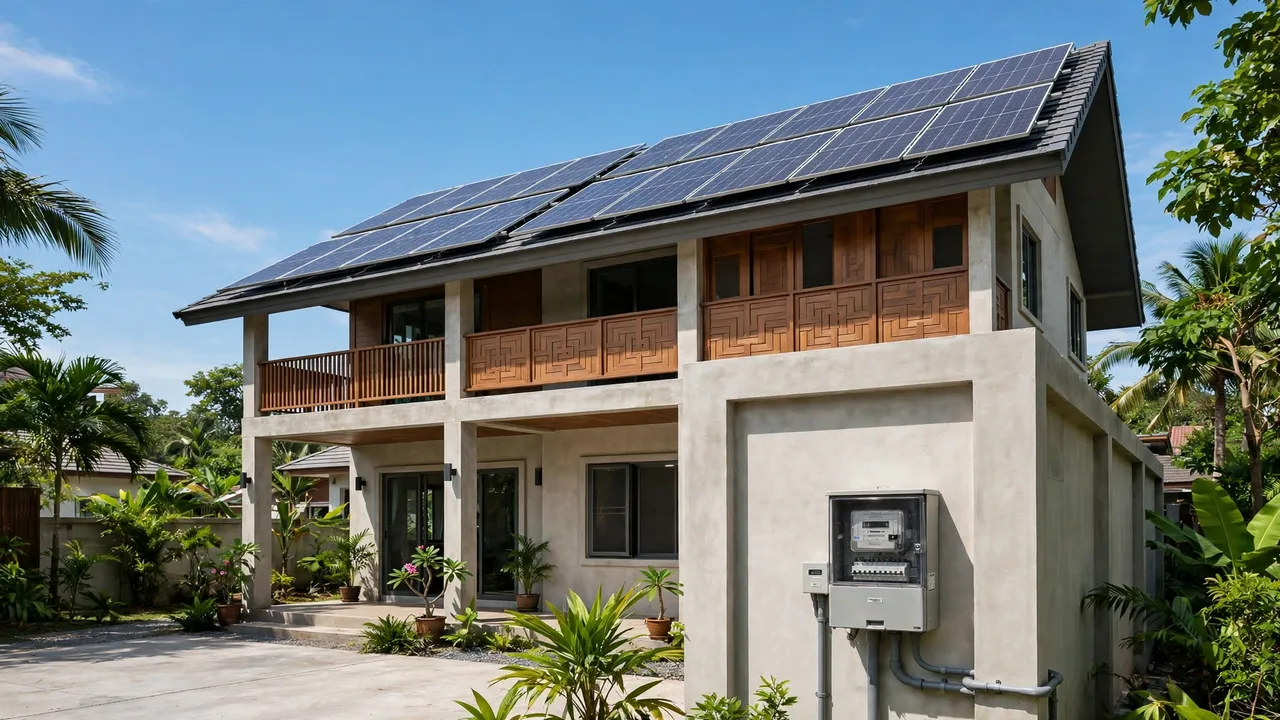
A 5-kilowatt array needs about 25 to 30 square metres without shade, ideally facing south, east or west, and the roof must be sound for another 25 years. If your roof cannot take panels, ground-mounted or floating systems are covered by the programme — ask the vendor about those options rather than forcing panels onto a weak roof.
The two trade-offs: tax exemption and welfare subsidies
Taking this subsidy means giving up the income-tax exemption for home solar equipment and installation under Royal Decree No. 805, which allows a deduction of up to 200,000 baht. For a higher-rate taxpayer with a large system, the tax exemption can be worth more than 50,000 baht in cash terms — for a lower-income household that pays little or no income tax, it may be worth nothing at all. This is a genuine either-or choice, and the right answer depends on your tax position. If you pay significant income tax, compare the two benefits with real numbers before you register for either.
State-welfare recipients face a sharper trade-off. You may receive the solar support, but you must waive state electricity-bill subsidies for all your meter numbers for 20 years from the date of successful grid connection, and the solar meter cannot claim welfare electricity subsidies again for those 20 years. Twenty years is a long time to give up a certain monthly help in exchange for a one-off 50,000 baht and uncertain solar savings. Welfare households should do this maths with particular care, and should not let a vendor rush the decision.
Finally, the scam warning that belongs in every guide about a popular subsidy: registration is free, the subsidy is never unlocked by a fee, and no official will ask for your password or a payment to reserve your slot. Anyone offering to register you for a fee, to jump the queue, or to guarantee your subsidy is not helping you. Register only through the MEA/PEA portal or a utility service point, and check any message against the official conditions before you act on it.