Thailand's 50,000 Baht Solar Subsidy Is Open: 1 Million Homes, Registration Until 31 January 2027
Published: 2026-10-28 · Via: ThaiRath
Here is the answer first, because the clock is already running. Thailand's People's Solar Project opened registration on 27 October 2026, and it will pay 50,000 baht toward a home solar system for 1 million households. Registration closes on 31 January 2027, or earlier if all 1 million slots are taken. If your home qualifies — Thai national, residential tariff, your name on the meter — and your roof gets good sun, this is the most generous home-solar offer Thailand has ever made. If your name does not match the meter, fix that at the electricity authority before you register, because that single mismatch is the mistake most likely to cost you the whole subsidy.
The offer in one paragraph: the cabinet approved 50 billion baht on 27 October 2026, which is exactly 50,000 baht times 1 million households. The systems covered are 5 to 10 kilowatts per meter, on a roof, on the ground, or floating. You register through the Metropolitan Electricity Authority (MEA) or the Provincial Electricity Authority (PEA) at peoplesolar.mea.or.th, or at a one-stop service point at your utility. You install through an approved route, request grid connection by 31 August 2027, complete it by 30 September 2027, and the 50,000 baht is paid by 31 December 2027 if every condition is met. A low-interest loan covers the rest of the cost for households that need it, and surplus electricity sells back to the grid at 2.20 baht per unit. Everything below explains each of those sentences properly, including the two trade-offs that make this a bad deal for some households.
What happened on 27 October
At 1 p.m. on 27 October 2026, at the Santi Maitri Building inside Government House, Prime Minister Anutin Charnvirakul — who is also the Interior Minister — presided over the inauguration ceremony for the People's Solar Project, in front of cabinet members and officials from the relevant agencies. The ceremony ended the way such ceremonies do, with the Prime Minister and the governors of the MEA and PEA placing a model solar panel on a mock rooftop on the stage. The substance behind the ceremony was a cabinet resolution passed the same day, approving the 50-billion-baht programme as part of the government's energy-transition policy.
The Prime Minister's opening remarks framed the project as larger than panels. Promoting clean and alternative energy, he said, is a key government policy and a global priority for strengthening the country's energy security. The project is not merely about installing solar panels on rooftops, he said, but about transforming sunlight into opportunities for citizens — turning roofs into energy producers, changing electricity expenses into family savings, and transforming energy consumers into active contributors to national power production. He also tied the programme to trade: reducing carbon dioxide emissions helps Thailand stay competitive in export markets where buyers increasingly require goods made with renewable energy, and it supports the country's preparations for joining the Organisation for Economic Co-operation and Development.
The ministries behind the project tell you how seriously the government is taking delivery. The MEA and PEA run it under the supervision of the Ministry of Interior, integrated with the Ministries of Finance, Energy and Labour. The Prime Minister instructed every relevant agency to prioritise citizens, simplify processes, cut unnecessary steps, move faster and more transparently, and hold strict electrical safety standards. Whether that instruction survives contact with a million applications is something the coming months will show — but the instruction itself, and the one-stop service points where bank staff sit alongside utility staff, suggest the government knows the last solar rounds were slowed by paperwork as much as by money.
Why now: the energy-price story behind the subsidy
The timing is not an accident. Thailand imports much of its energy, and about 60 percent of its electricity production comes from natural gas, with renewables at almost 11 percent in the January-to-July 2026 government figures. Declining domestic gas production has forced the country to import more liquefied natural gas, and imported LNG made up 32 percent of natural gas in that period. When war in the Middle East disrupted energy infrastructure, including Qatar's gas facilities, the exposure of Thai household bills to global markets became a political problem as well as an economic one.
The government has described the programme as a shield against exactly that exposure. The Energy Minister said last month that the programme aims to protect Thai people from soaring energy prices driven by the Middle East war. The Finance Minister, Ekniti Nitithanprapas, put it more bluntly when the package was announced: Thailand imports a lot of energy and is among the top buyers globally, and that is not a sustainable solution. The People's Solar Project is the household-facing half of that answer — the other half, approved the same day, included a cut in biofuel taxes and more than 20 billion baht of smart-grid investment so households can actually sell their surplus power back.
The scale of the ambition is visible in the government's own estimates. The programme is expected to cut household electricity costs by more than 24.5 billion baht a year, and to cut purchases from the existing grid by about 6,323 million units in the first year, according to the figures quoted in the launch coverage. Those are programme-wide estimates, not promises to any single household. Your home's saving depends on your system size, your daytime electricity use, and whether your roof is shaded — which is why the calculator linked to this story asks for your own vendor quote rather than handing you a national average.
The money: 50,000 baht flat, and what it leaves you paying
The subsidy is a flat 50,000 baht per household. It does not scale with system size: a 5-kilowatt system and a 10-kilowatt system attract the same 50,000 baht. That single fact should shape your choice of system size, because the subsidy covers a bigger share of a smaller system, while a bigger system saves more on bills but leaves you paying more of the difference yourself.
A vendor illustration circulating since the launch makes the arithmetic concrete. A 5-kilowatt system is quoted at about 140,000 baht. Subtract the 50,000 baht subsidy and the household pays 90,000 baht. That illustration is a vendor's example, not a government price — real quotes vary by roof, equipment and installer, and you should collect more than one before committing. The calculator linked to this story runs the same subtraction on your own quote, and adds the loan instalment and the payback time, so you can see your own numbers instead of a stranger's.
The payment timing matters as much as the amount. The subsidy is not paid when you register, and it is not paid when you sign with a vendor. It is paid after installation and successful grid connection, by 31 December 2027, if every condition is met. If you pay cash, you pay the installer in full and are reimbursed to your PromptPay account. If you take a loan, the bank pays the installer and the government transfers the subsidy directly to the bank. Either way, you need the cash or the loan in place before the panels go up — the subsidy will not fund your deposit, and a vendor who asks you to pay everything upfront while promising the subsidy will arrive later deserves careful scrutiny.
Who qualifies — and the meter-name rule
The published conditions are short. You must be a natural person holding Thai nationality. You must be a residential electricity user under category 1. Your name must be the same as the owner of the meter where the solar system is installed. The support can be used only once per person for the whole project. And the tax and welfare conditions explained below apply in full.
Two exclusions catch people by surprise. Temporary meters are excluded, and condominiums are excluded. The programme is for houses with their own meter, not for temporary supplies or condo units. If you bought a second-hand home, check the meter before anything else: buyers of second-hand homes must make sure the meter is transferred into the correct owner name, because the name rule is checked against the utility's own records.
The name rule deserves its own paragraph, because it will decide more applications than any other condition. A nickname, a married name that was never updated, a parent's name on a family home, or a previous owner's name on a second-hand home all fail it. The fix is simple but only works in one order: go to the electricity authority, transfer or correct the meter owner name to your own name, keep the confirmation, and then register. Registering first with a mismatched name and hoping the utility sorts it out later is the mistake this story most wants you to avoid.
There is one generous side to the rules. One entitlement applies per meter, not per person, so a person who owns several meters may register each home separately. A central database checks for duplication, so registering the same meter twice will be caught — do not try it.
Registration step by step
Step one is the checks above, including the meter name, done before you touch the portal. Step two is registration itself: online at peoplesolar.mea.or.th, or in person at a one-stop service point at your electricity authority, where participating banks also serve customers. Identity verification for online registration runs through the ThaiD application; in-person verification happens at the local authority office. Have your Thai ID and your meter details ready, and save or photograph your registration confirmation.
Step three is the site survey. About 400 vendors accredited by the utilities will inspect registered homes for technical suitability — roof strength, sunlight orientation, shading — and surveys are due to be completed by 30 June 2027. Step four is the contract: sign only with MEA, PEA or a registered vendor, and check that every tax invoice is dated from 27 October 2026 onward. An earlier invoice does not count, even for identical equipment.
Step five is installation, with at least panels and an inverter, on a roof, on the ground, or floating. Step six is the grid connection request — through the MEA MyEnergy system or the PEA PPIM system — by 31 August 2027, with the connection completed by 30 September 2027. Step seven is the payment, by 31 December 2027 if every condition is met. Keep every document at every step: ID, meter details, contract, invoices, meter serial number, and dated installation photographs. They are your evidence if anything is disputed later.
The loan: 2.5 percent, 7 years, no credit-bureau check
For households that cannot pay the balance after the subsidy in cash, three state banks will lend it: the Government Savings Bank, the Government Housing Bank (GH Bank), and the Bank for Agriculture and Agricultural Cooperatives (BAAC). The reported terms are a uniform 2.5 percent a year over 7 years, with the solar system itself as collateral, instalments collected through your electricity bill, and no credit-bureau check. During the repayment period the banks also guarantee the systems and provide panel-cleaning services to keep generation up.
Run the numbers before you sign. On the vendor illustration of a 140,000 baht system, the 90,000 baht balance over 7 years at 2.5 percent works out to roughly 1,170 baht a month on a standard annuity calculation; the vendor's own illustration, on a slightly different basis at 2.2 percent, comes to about 1,236 baht a month. Your real instalment follows your real quote and your bank's final terms, so confirm the bank's own schedule rather than trusting any article's arithmetic — including this one.
The benefit figures need the same caution. The Nation reports monthly savings of approximately 1,100 baht once the seven-year loan is repaid, with the household keeping the full benefit for the panels' remaining life of around 13 years on a 20-year lifespan. The Finance Minister has separately described a net income of roughly 700 to 1,000 baht a month during repayment, after loan instalments are deducted from electricity-sales income. Both are reported estimates, not guarantees, because generation depends on weather and sunlight and no exact output can be promised.
Selling surplus power — and why using it yourself pays double
Surplus electricity sells back to the grid at 2.20 baht per unit, under a 20-year arrangement. The buy-back covers up to 5 kilowatts even if your system is larger, so the extra capacity of a 10-kilowatt system is worth it only if your home uses that power itself. The utility will swap your meter for a free smart meter as part of the process.
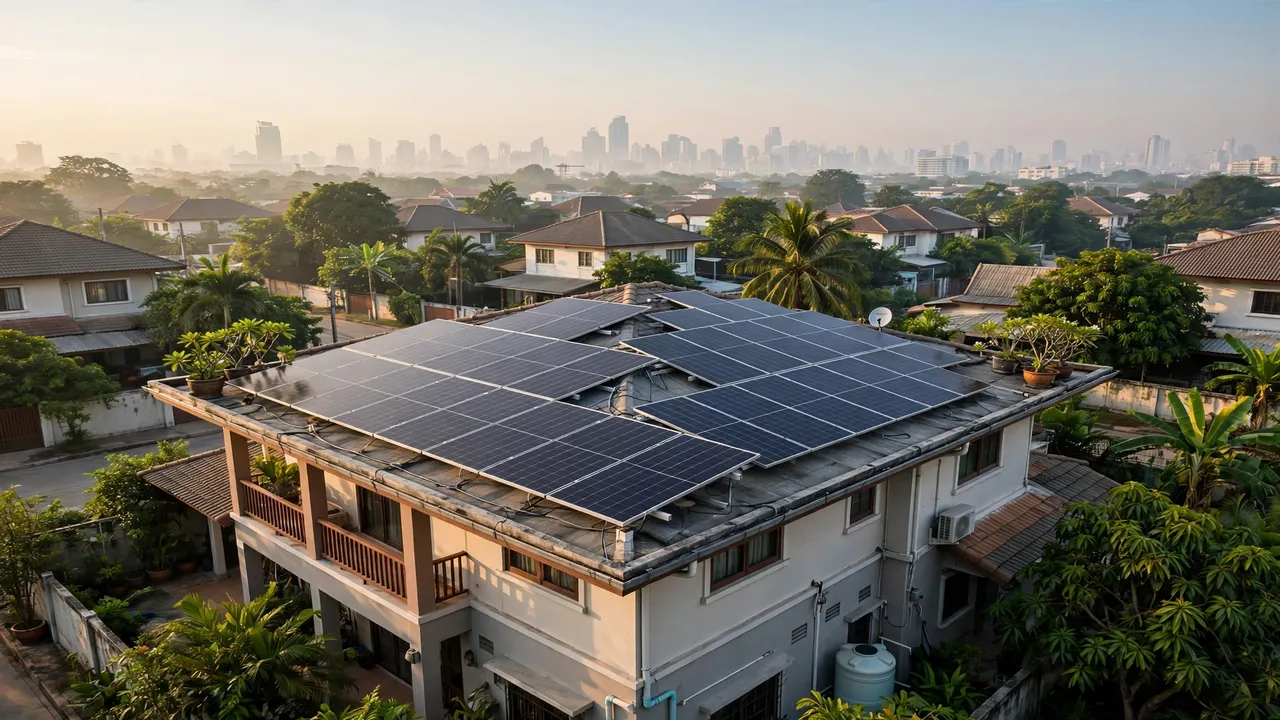
Here is the design lesson that matters more than any subsidy figure: a unit you use yourself is worth roughly twice a unit you sell back. Self-used power replaces electricity bought at the retail tariff of roughly 4 to 5 baht per unit, while exported power earns only 2.20 baht. Homes that use a lot of electricity during daylight hours — someone at home, a home office, a shop, daytime appliances — recover their cost fastest. The ministry has said homes with bills of about 3,000 to 4,000 baht a month benefit most. A 5-kilowatt array needs about 25 to 30 square metres without shade, ideally facing south, east or west, and the roof must be sound for another 25 years. If your roof cannot take panels, ask about ground-mounted or floating options rather than forcing panels onto a weak roof.
The two trade-offs you must weigh before registering
The first trade-off is tax. Anyone who receives this support cannot claim the income-tax exemption for home solar equipment and installation under Royal Decree No. 805, which allows a deduction of up to 200,000 baht. For a higher-rate taxpayer with a large system, that exemption can be worth more in cash terms than 50,000 baht. For a household that pays little or no income tax, it may be worth nothing at all. This is a genuine either-or choice, and the right answer depends on your tax position. If you pay significant income tax, compare the two benefits with real numbers before you register for either.
The second trade-off is sharper, and it falls on the poorest households. State-welfare recipients may receive the solar support, but they must waive state electricity-bill subsidies for all their meter numbers for 20 years from the date of successful grid connection, and the solar meter cannot claim welfare electricity subsidies again for those 20 years. Twenty years is a long time to give up a certain monthly help in exchange for a one-off 50,000 baht and uncertain solar savings. Welfare households should do this maths with particular care, and should not let any vendor rush the decision.
Scams, and what to do today
Every popular subsidy breeds its own scams, and this one will be no different. Registration is free. The subsidy is never unlocked by a fee. No official will ask for your password, your one-time code, or a payment to reserve your slot. Anyone offering to register you for a fee, to jump the queue, or to guarantee your subsidy is not helping you. Register only through the MEA/PEA portal or a utility service point, and check any message against the official conditions before you act on it.
What should you do today? First, check the five eligibility conditions, starting with the meter name, and fix anything that fails. Second, collect two or three vendor quotes and ask each vendor to estimate your generation and your self-use from your actual bills — not from a brochure. Third, run your own quote through the calculator linked to this story, and compare the subsidy against the tax exemption if you pay income tax, or against 20 years of welfare electricity help if you receive it. Fourth, register before 31 January 2027 — and remember that the window can close earlier if the 1 million slots fill first.
This is an independent guide, not an official MEA or PEA announcement. The figures here reflect the cabinet approval and the MEA/PEA guidance as reported on 27 October 2026, and programme details can change. Before you pay any vendor or sign any loan, confirm the final conditions at the People's Solar portal, because those conditions — not a headline — decide whether you actually receive 50,000 baht.
Frequently asked questions
How much is the subsidy and how many households get it?
50,000 baht per household for 1 million households, from a 50-billion-baht budget approved on 27 October 2026.
When does registration close?
31 January 2027, or earlier if all 1 million slots are filled.
Where do I register?
At peoplesolar.mea.or.th, or at a one-stop service point at your electricity authority.
What size system qualifies?
5 to 10 kilowatts per meter, on a roof, on the ground, or floating, with at least panels and an inverter.
Does my name have to match the meter?
Yes, exactly. If it does not match, change the meter name at the electricity authority before you register.
When do I get the money?
After installation and grid connection: request connection by 31 August 2027, complete it by 30 September 2027, and the payment follows by 31 December 2027 if all conditions are met.
Can I borrow the rest?
Yes: state banks offer 2.5 percent a year over 7 years, no credit-bureau check, with the system as collateral and instalments collected via your electricity bill.
What do I earn for surplus power?
2.20 baht per unit, for up to 5 kilowatts, under a 20-year arrangement.
Can I claim the tax exemption too?
No. Taking the subsidy means giving up the 200,000 baht income-tax exemption for home solar under Royal Decree No. 805.
I get state welfare. Should I join?
You may, but you waive electricity-bill subsidies for all your meters for 20 years from grid connection. Do that maths very carefully before deciding.
Are condominiums eligible?
No. Condominiums and temporary meters are excluded.
Can I register twice for two meters I own?
Yes: one entitlement per meter, so each home you own can be registered separately, but each meter only once.
What if my vendor survey fails?
Ask the vendor in writing why — roof strength, shading, or size — and whether a smaller, ground-mounted or floating option works.
Is registration free?
Yes. Anyone charging a fee to register you, reserve a slot, or guarantee the subsidy is running a scam.
Where is the official information?
The MEA/PEA People's Solar portal at peoplesolar.mea.or.th. Confirm final conditions there before paying any vendor.