India: UPI Will Now Pay Banks to Put QR Codes in Small Shops — Here's What It Means for You
Published: 2026-11-14 · Via: ET BFSI — NPCI Launches UPI Vyapaar Saksham Scheme
A quiet circular, a big change for the corner shop
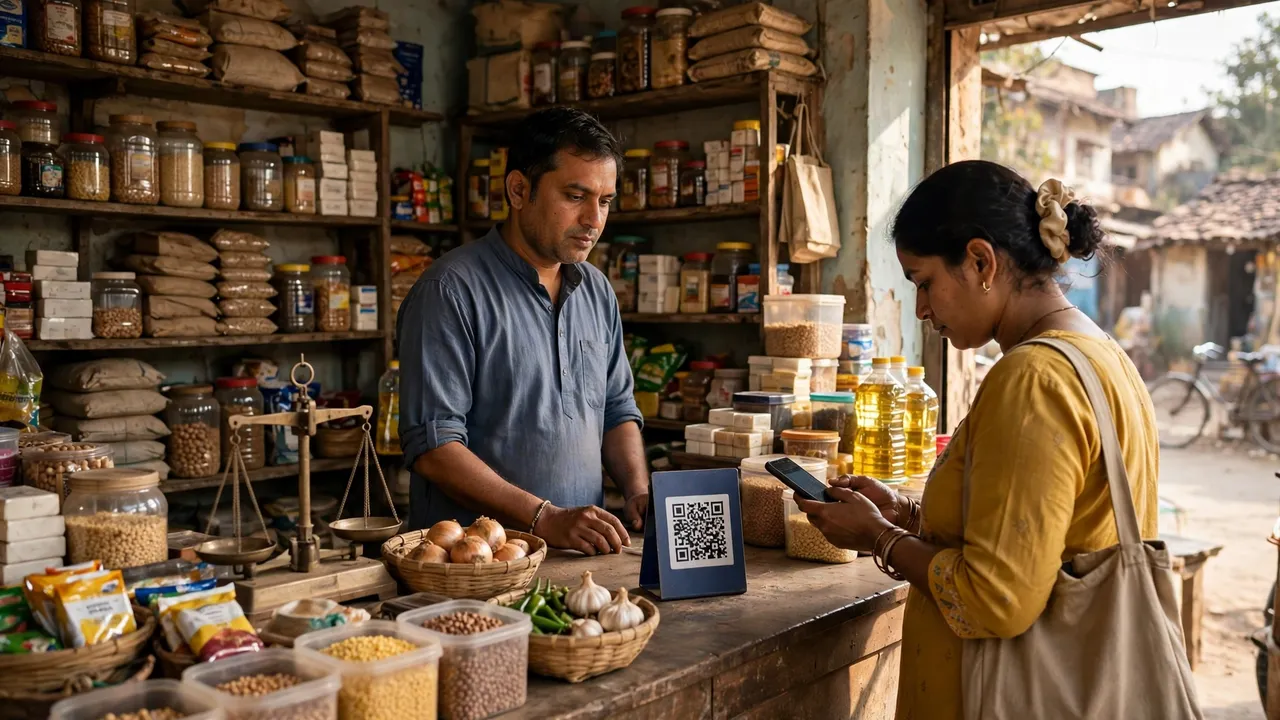
On 11 November 2026, the National Payments Corporation of India — NPCI, the body that runs UPI — issued a circular with a name most shop owners have never heard before: the UPI Vyapaar Saksham Scheme. It did not make the front pages. There was no press conference, no minister on television, no banner on a government portal. And yet, if you run a kirana store, a tea stall, a tailoring shop, a small vegetable cart with a QR code taped to the counter, this circular is about you. It is about who pays for the QR code stuck to your wall, who pays for the little soundbox that announces "Rs 50 received" every time a customer scans, and — for the first time in the six years UPI has been free — about the fee that will quietly arrive alongside it.
The story broke the next day. ET BFSI reported it on 12 November 2026 at 19:30 IST, and through 13 November it was picked up by ETV Bharat, MySandesh, IBTimes, Gadgets360, StartupFeed and eLets. The headlines mostly said the same thing: NPCI will pay for QR codes and soundboxes. That is true, but it is only half the story, and the half that was left out is the half that matters most to a small merchant. The money does not go to the merchant. It goes to the bank. The shop pays nothing — but the shop also receives nothing directly. What the shop gets is a free QR code, a free soundbox, and a reason for its bank to finally come to its door. That distinction, blurred in most early reports, is where this story actually begins.
The one-paragraph answer
Here is the whole scheme in one paragraph, before we get into the detail. NPCI has created a fund, taken from 5% of the UPI merchant fees that banks will collect once those fees begin, and will use that fund to pay acquiring banks and payment service providers — the companies that put QR codes in shops — Rs 300 for every physical QR code they install at a new eligible merchant outlet, and Rs 750 for every soundbox they fit there, provided the merchant then actually uses UPI: at least 25 eligible transactions in at least two of the three months in a quarter, with at least Rs 5,000 of transaction value each month. The scheme is aimed at small merchants with annual turnover up to Rs 40 lakh, with a focus on Tier 3 to Tier 6 towns, the North-Eastern states, Jammu and Kashmir and Ladakh, and it also covers merchants under the PM SVANidhi and PM Vishwakarma schemes. It runs for three years from the date UPI merchant fees — MDR — are implemented. And there is the catch that every shop owner should know before getting excited: no start date has been fixed yet.
Who actually gets the money — the twist most headlines blur
Read the headlines again and you will see the blur. "NPCI offers incentives for QR codes and soundboxes." Incentives for whom? A shop owner reading that in a hurry could be forgiven for thinking a cheque is coming to the shop. It is not. The Rs 300 per QR code and the Rs 750 per soundbox are paid to the acquiring bank or payment service provider — the bank or fintech company that onboards the merchant and installs the equipment. The merchant's benefit is indirect but real: the QR code and the soundbox cost the shop nothing. Nobody should ask the shop to pay for them under this scheme, and nobody should promise the shop a cash payment for taking one.
Why does it work this way? Because the problem NPCI is trying to solve is not that shops refuse QR codes. It is that banks have had little financial reason to chase the smallest merchants. A kirana store doing Rs 40,000 a month in UPI payments earns its bank almost nothing, and sending an agent to a small town to install a soundbox costs real money. For six years UPI was free, so there was no fee income to pay for that effort at all. The Vyapaar Saksham scheme changes the arithmetic for the bank: go to the small town, fit the QR code, fit the soundbox, and if the merchant actually uses it, the bank gets Rs 1,050 for that outlet — Rs 300 plus Rs 750 — plus further rewards as the merchant's UPI volumes grow. The shop gets the equipment free. The bank gets paid to do the legwork. That is the deal, and it is worth understanding clearly, because anyone who comes to your shop asking for money in the name of this scheme is not part of it.
What happened, and when
The sequence matters, because the scheme did not arrive out of nowhere. UPI has been free for roughly six years — no fee for the customer, no fee for the merchant, on any payment. That freeness was the reason UPI spread to every corner of India, but it also meant nobody earned anything from running it, and the cost of reaching the smallest merchants fell on banks with no income to cover it.
In September 2026, the law changed. The Payment and Settlement Systems Act was amended to allow a merchant fee — MDR, or merchant discount rate — on UPI payments. A fee had been planned from 15 October 2026, but after pushback from shops and retail bodies it was deferred past Diwali, and no new date was fixed. Reports now point to a possible January 2027 start, but NPCI had not fixed a date as of the 11 November circular, and that remains the position. The Vyapaar Saksham scheme, announced in that 11 November circular, is the other half of the same decision: the fee will be charged, and a slice of it will be used to pay banks to bring small merchants onto UPI properly.
The circular's name is worth spelling out because it is being spelled two ways in reports. NPCI's spelling, followed by ET BFSI, is "Vyapaar" — UPI Vyapaar Saksham Scheme. Some reports write "Vyapar". They are the same scheme. If you search for it, try both spellings.
Who qualifies
The scheme is drawn deliberately narrow. It is not for every shop with a QR code. It is for the small merchant, and the circular defines small in a specific way.
First, turnover. The merchant's annual turnover must be up to Rs 40 lakh in the previous financial year. A shop that turned over more than Rs 40 lakh last year is not eligible under this scheme. Note the words: up to Rs 40 lakh, in the previous financial year. It is last year's turnover that counts, not this year's, and not a guess about next year.
Second, place. The focus is on Tier 3 to Tier 6 centres — the smaller towns and rural centres that sit below the big metros and the larger cities — and on the North-Eastern states, Jammu and Kashmir, and Ladakh. The scheme is aimed squarely at the places where digital payments have spread slowest, where a bank agent visiting with a soundbox still makes a difference. A small merchant in a big city is not the target, though the scheme's growth rewards, as we will see, pay extra in the target geographies — a deliberate tilt towards the towns that need it most.
Third, two named central schemes. Merchants covered under notified central schemes — PM SVANidhi, the scheme for street vendors, and PM Vishwakarma, the scheme for traditional artisans and craftspeople — are also eligible. That matters because it connects the UPI scheme to two large, existing beneficiary lists: the street vendor who already has a SVANidhi loan, and the carpenter, tailor, blacksmith or potter recognised under Vishwakarma. If you are in either scheme, you are in the frame for this one too.
Fourth, the outlet must be new. The Rs 300 and Rs 750 are paid for a QR code and a soundbox fitted at a new eligible merchant outlet. This is an onboarding incentive — it pays banks to bring in merchants who are not yet on UPI, or not yet properly equipped, not to re-pay for equipment already installed.
The usage test, in plain words
Here is the part that decides whether the bank actually gets paid — and therefore whether the bank bothers to come at all. The money is not paid just for sticking a QR code on a wall. The merchant has to use it.
The test is measured every quarter, and it has two parts. The merchant must do at least 25 eligible UPI transactions in at least two of the three months in a quarter. And the merchant's minimum monthly transaction value must be at least Rs 5,000. Both conditions, together, in at least two months out of three.
Put that into the life of a real shop and it looks like this. Take a kirana store in a Tier 4 town — say, a shop in a small town in Uttar Pradesh or Bihar, turning over Rs 25 lakh a year, well inside the limit. The bank fits a QR code and a soundbox in the first week of a quarter. In the first month, customers scan and pay 40 times, adding up to Rs 18,000. In the second month, a quiet month, only 20 payments come through UPI, worth Rs 4,200 — that month fails both parts of the test, fewer than 25 transactions and less than Rs 5,000. In the third month, 32 payments worth Rs 12,500. Two months out of three pass — the first and the third — so the usage test clears, and the bank earns its Rs 300 for the QR code and Rs 750 for the soundbox: Rs 1,050 for that outlet. If only one month had passed, the bank would get nothing for the equipment, however neatly it was installed. That is the point of the test. NPCI is paying for usage, not for hardware sitting unused on a counter.
There are rules about which transactions count. Eligible transactions are up to Rs 2,000 each — a payment above Rs 2,000 does not count towards the test. Reversed, refunded or cancelled payments do not count either. And one rule is written as a warning: splitting one bill to stay under Rs 2,000 is banned. A customer whose bill is Rs 3,500 cannot be asked to pay it as two scans of Rs 1,750 so that both count. The circular forbids it, and a merchant who does it risks the transactions being disqualified.
For most small shops, the test is not hard. Twenty-five transactions a month is roughly one a day. Rs 5,000 a month in UPI value is a modest sum for any shop that takes digital payments at all. The test is designed to be passable — but it must be passed, month after month, quarter after quarter, for the money to keep flowing.
The fund: where the money comes from, and the three components
The scheme is not paid for from a government budget handed to NPCI. It is paid for from the fee itself. Five per cent of UPI MDR collections from member banks and payment service providers goes into the scheme's fund. In other words, once merchants start paying the fee on larger payments, a small slice of everything collected is set aside to pay for bringing small merchants on board. The fee funds its own expansion.
That fund is split into three components, and each one pays for something different.
Component A is 30% of the fund, and it is the onboarding money: the Rs 300 per physical QR code and the Rs 750 per soundbox, paid once the usage test clears. This is the headline component, the one in all the reports, and it is the one that gets equipment into shops.
Component B is 50% of the fund — the biggest share — and it is the growth reward. It pays 0.03% of the aggregate eligible transaction value, with 50% extra in the target geographies, and it needs at least 5% quarter-on-quarter growth. Take the circular's own arithmetic and make it concrete. A merchant whose eligible UPI volume in a quarter is Rs 1 lakh earns a growth reward of Rs 30 — 0.03% of Rs 1 lakh. If that merchant is in a target town, the reward is 50% higher: Rs 45. That is a small sum, and it should be said plainly: Component B is not a fortune for any single shop. It is a volume reward, paid to the bank, and it only keeps coming if the merchant's UPI business keeps growing by at least 5% each quarter. The growth condition is the discipline in the scheme — it rewards banks whose merchants genuinely transact more, not banks that sign up shops and walk away.
Component C is 20% of the fund, and it is the incremental reward. It pays 0.20% of the rise over the previous quarter in the target geographies. Again, take a worked example from the circular's rates. A merchant in a target geography whose eligible UPI volume rises by Rs 20,000 over the previous quarter earns an incremental reward of Rs 40 — 0.20% of Rs 20,000. Like Component B, this is paid to the bank or payment service provider, and like Component B, it is small money per shop. Its purpose is direction: the extra rewards point towards the target towns and the target states, where NPCI most wants UPI to grow.
Add the three together and the shape of the scheme is clear. Component A pays for the equipment. Components B and C pay, in small amounts, for growth and for growth in the right places. Nothing in the scheme pays the merchant directly. The merchant's gain is the free QR code, the free soundbox, and the customers who can now pay digitally.
NPCI has set itself a scale target alongside the money: up to 1 crore new QR codes a year. One crore new QR codes, every year, fitted at small merchants. That is the ambition behind the Rs 300 and Rs 750 — not a handful of soundboxes in a pilot district, but a national rollout measured in crores.
The MDR background: what merchants will pay, and what stays free
None of this makes sense without the fee that funds it, so here is the MDR picture as it stands — noting carefully that the fee has not yet started, and its start date has not been fixed.
The merchant fee is 0.4% on merchant payments above Rs 2,000, capped at Rs 300. The cap bites on very large payments: payments of Rs 75,000 and above hit the Rs 300 ceiling, so no merchant payment costs more than Rs 300 in UPI fees. Person-to-person transfers are free — sending money to a friend or family member costs nothing. Payments up to Rs 2,000 are free — the small everyday payment, the cup of tea, the packet of biscuits, the Rs 500 grocery bill, carries no fee at all. And small merchants taking up to Rs 1 lakh a month through a personal QR code pay zero.
Read that last line again, because it is the most important protection in the whole design. A small merchant whose UPI collections through a personal QR code stay within Rs 1 lakh a month pays no MDR at all. The fee is aimed at larger merchant payments, above Rs 2,000 each, and even there it is 0.4% with a Rs 300 cap. The fear that every small shop will suddenly pay a fee on every scan is not what the circular describes. The small payment stays free. The small merchant stays free, within the Rs 1 lakh monthly limit.
That is also why the earlier history matters. UPI was free for about six years, and that freeness built the habit. In September 2026 the Payment and Settlement Systems Act was changed to allow the fee — the legal step that made MDR possible. The fee was first set for 15 October 2026, then deferred past Diwali after pushback from shops and retail bodies. That pushback is part of the story, not a footnote: the people who will pay the fee objected, and the start was pushed back. Reports point to a possible January 2027 start, but nothing has been fixed, and NPCI had not fixed a date as of the 11 November circular.
There is also an earlier scheme worth knowing about, because it shows this is not NPCI's first attempt at paying for small payments. An earlier 2025 scheme paid a flat 0.15% on small payments, straight from a Rs 1,500 crore budget. The Vyapaar Saksham scheme replaces that approach with something more targeted: instead of a flat percentage on every small payment, the money now goes to onboarding equipment and to growth, and it is funded from the fee itself rather than from a fixed budget. The shift in design tells its own story — from paying for transactions to paying for merchants.
Why there is no start date yet — and what to watch for
The single most confusing thing about this scheme, for any shop owner reading about it, is that it has been announced but has no start date. That is not an oversight in the reporting. It is the position. The scheme runs for three years from the date UPI MDR is implemented — and that date has not been fixed. The fee was meant to start on 15 October 2026, was deferred past Diwali after pushback from shops and retail bodies, and reports now point to a possible January 2027 start. NPCI had not fixed a date as of the 11 November circular. Until the MDR start date is fixed, the three-year clock has not started, and the onboarding money cannot flow, because the fund itself is 5% of MDR collections that do not yet exist.
What should a shop owner watch for? Three things. First, the MDR start date — the announcement that fixes the day the fee begins. That is the date the scheme's clock starts. Second, the claim process — how a bank actually claims the Rs 300 and the Rs 750, and what a merchant needs to do, if anything, to be counted. That process has not yet been announced. Third, any NPCI update on the scheme itself. NPCI reviews the scheme every six months, so the rules can change — the rates, the usage test, the geographies — and a shop owner who signed up under one version should expect the possibility of a revised version later.
There is one more honest note about sources. The NPCI UPI circulars page is the official home for NPCI circulars, but the Vyapaar Saksham circular was not listed there publicly at the time of the announcement. That does not make the scheme unreal — the reporting across ET BFSI, ETV Bharat, MySandesh, IBTimes, Gadgets360, StartupFeed and eLets is consistent and detailed, and it traces back to the 11 November circular — but it does mean the official circular text itself was not publicly visible on NPCI's circulars page when the story broke. Readers should know that, and should check the NPCI circulars page for the listing as the scheme moves towards launch.
What a shop owner should do now
For a small merchant reading this and wondering what to do on Monday morning, the honest answer is: not very much yet, but three small things are worth doing.
First, ask your bank. The scheme works through acquiring banks and payment service providers. Your bank — the bank whose QR code is already on your counter, or the bank where your current account sits — is the one that will fit the QR code and the soundbox and claim the incentive. Ask them whether they are onboarding merchants under the Vyapaar Saksham scheme, and when they expect to start. If they have no answer yet, that is normal: the scheme has no start date, and banks are waiting for one too.
Second, keep transacting. If you already take UPI, the habit is the preparation. The usage test rewards shops that already transact — 25 transactions in at least two months of a quarter, Rs 5,000 a month. A shop that builds that pattern now will clear the test easily when the scheme starts. A shop that waits for the scheme to start before taking UPI seriously will be starting from zero.
Third, check your turnover and your town. If your annual turnover last year was up to Rs 40 lakh, you are inside the limit. If your shop is in a Tier 3 to Tier 6 centre, in the North-East, in Jammu and Kashmir or in Ladakh, you are in the focus area. If you are a PM SVANidhi street vendor or a PM Vishwakarma artisan, you are covered too. Knowing where you stand takes five minutes, and it means you will recognise the scheme when your bank mentions it, instead of wondering whether it is for you.
And one thing a shop owner should not do: pay anyone. The QR code costs the shop nothing. The soundbox costs the shop nothing. No fee, no agent, no middleman.
Fraud warnings: who will try to charge you for something free
Every scheme that promises free equipment attracts someone who will try to sell it. The warnings here are simple, and they follow directly from how the scheme works.
Nobody should ask you to pay for a QR code or a soundbox under this scheme. The incentive is paid by NPCI to the bank, not by the merchant to anyone. If someone comes to your shop asking for Rs 500 or Rs 1,000 for a QR code "under the Vyapaar Saksham scheme", that is not the scheme. It is a sale, or a scam, using the scheme's name.
Nobody should promise you a cash payment for taking a QR code. The Rs 300 and the Rs 750 go to the bank, not to the merchant. Anyone promising you Rs 300 for a QR code or Rs 750 for a soundbox is either confused or dishonest. The merchant's benefit is the free equipment.
Nobody from NPCI will call you to collect your bank details, your UPI PIN, or an OTP to "activate" the scheme. NPCI does not onboard merchants directly. Your bank does. Any call, message or WhatsApp forward claiming to be from NPCI and asking for money, a PIN, or an OTP is fraud. Do not share your UPI PIN or any OTP with anyone, for any reason, under any scheme's name.
Be careful with agents. Only your bank or its authorised payment service provider should be fitting equipment at your shop. If a stranger arrives claiming to be from a bank you do not use, ask for identification, and call your own bank to check before letting them install anything or take any details. A genuine onboarding visit costs you nothing and asks for no payment. That is the test: if money is asked for, walk away.
What is not yet known
A responsible account of this scheme must say plainly what it does not yet know, and there is a lot of it. The start date is not yet announced — reports point to a possible January 2027 start, but NPCI had not fixed a date as of the 11 November circular, and the earlier 15 October 2026 date was deferred. The portal, if there is to be one for merchants, is not yet announced — and it is not yet clear whether merchants will need to register anywhere at all, or whether onboarding will happen entirely through their bank. The claim process — the exact steps by which a bank claims the Rs 300 and Rs 750, and what proof of usage it must show — is not yet announced. Whether the rates will change at the first six-monthly review is not yet known; NPCI reviews the scheme every six months, and the review could raise, lower, or reshape the incentives. The full list of eligible geographies beyond the stated focus — the exact definition of Tier 3 to Tier 6 centres for this scheme — is not yet announced in the public reporting. And the official circular itself was not listed on NPCI's UPI circulars page publicly at the time of the announcement, so the fine print remains to be seen in full. None of this makes the scheme doubtful. It makes it early. The announcement is real; the machinery is not yet running. This page will be updated as each of those unknowns is answered, and the date at the top will change when it is.
Why this scheme exists, and what it is really trying to do
Step back from the rates and the rules and the scheme has a clear purpose. UPI conquered India's payments by being free and by being everywhere — but "everywhere" was never quite true. The last mile of small merchants, in the smaller towns, in the North-East, in Jammu and Kashmir and Ladakh, is where the cost of onboarding was highest and the income from it was lowest, and for six years there was no income at all. Banks did not go there, or went slowly, because the numbers did not add up. The Vyapaar Saksham scheme is NPCI's attempt to make the numbers add up: charge a small fee on larger merchant payments, set aside 5% of it, and pay banks to do the expensive last-mile work — Rs 300 for a QR code, Rs 750 for a soundbox, small rewards for growth, bigger rewards where growth is hardest. It is a redistribution inside the payments system: the larger payments fund the onboarding of the smallest merchants.
Whether it works will depend on things the circular cannot guarantee. It will depend on whether banks actually send agents to Tier 5 and Tier 6 towns, or whether they collect the easy onboarding in bigger towns and leave the hard places alone. It will depend on whether the usage test is enforced honestly, so that the money rewards real transacting shops and not rows of QR codes stuck to shuttered counters. It will depend on whether the fee itself — 0.4% above Rs 2,000, capped at Rs 300 — is accepted by merchants once it starts, after the pushback that already deferred it once. And it will depend on the start date, which is still not fixed. A scheme with no start date is a promise, not yet a programme. The next announcement to watch is not another circular. It is a date.
A short checklist for the small shop owner
If you run a small shop and you have read this far, here is the whole scheme on one list. Check whether your annual turnover in the previous financial year was up to Rs 40 lakh. Check whether your shop is in a Tier 3 to Tier 6 centre, in the North-East, in Jammu and Kashmir, or in Ladakh — or whether you are covered under PM SVANidhi or PM Vishwakarma. Ask your bank whether it is onboarding merchants under the UPI Vyapaar Saksham scheme. Keep taking UPI payments, aiming for at least 25 transactions and Rs 5,000 a month, so the usage test is already your habit when the scheme starts. Do not split bills to stay under Rs 2,000 — it is banned, and those payments will not count. Pay nothing to anyone for a QR code or a soundbox under this scheme. Share your UPI PIN or OTP with nobody. And watch for the MDR start date — the day the fee begins is the day this scheme's three-year clock starts, and it is the announcement that will turn this story from a circular into something you can actually use.
Sources
This article is based on the NPCI circular dated 11 November 2026 as reported by ET BFSI on 12 November 2026 (19:30 IST), ETV Bharat on 13 November 2026 (12:18 IST), MySandesh on 13 November 2026 (14:57 IST), IBTimes on 13 November 2026 (17:55 IST), Gadgets360 on 13 November 2026 (16:25 IST), and StartupFeed and eLets. The official NPCI UPI circulars page is the authoritative source for the circular itself; the circular was not listed there publicly at the time of the announcement, and readers are advised to check there for the listing as the scheme moves towards launch. This is an independent guide, not a government or NPCI website. Published 14 November 2026. Figures, dates and eligibility rules are as reported in the sources above; anything not yet announced — including the scheme's start date, any merchant portal, and the claim process — is marked as such in the text, and this page will be updated when official details are confirmed.
Frequently asked questions
What is the UPI Vyapaar Saksham scheme?
It is an NPCI scheme announced in a circular dated 11 November 2026 that pays banks and payment service providers to put QR codes and soundboxes in small merchants' shops. The fund comes from 5% of UPI merchant fee (MDR) collections, and the scheme runs for three years from the date UPI MDR is implemented.
Who gets the Rs 300 for a QR code and Rs 750 for a soundbox — the shop or the bank?
The bank or payment service provider gets it, not the merchant. NPCI pays the acquiring bank Rs 300 per physical QR code and Rs 750 per soundbox fitted at a new eligible merchant outlet, once the usage test clears. The shop pays nothing for the equipment and receives no cash payment.
Does my shop have to pay anything for the QR code or soundbox?
No. Under this scheme the QR code and the soundbox cost the merchant nothing. Anyone asking you to pay for them in the scheme's name is not part of the scheme.
Which merchants qualify for the scheme?
Small merchants with annual turnover up to Rs 40 lakh in the previous financial year, with a focus on Tier 3 to Tier 6 centres, the North-Eastern states, Jammu and Kashmir and Ladakh. Merchants covered under the notified central schemes PM SVANidhi and PM Vishwakarma are also eligible.
What is the usage test my shop must pass?
At least 25 eligible UPI transactions in at least two of the three months in a quarter, with a minimum monthly transaction value of Rs 5,000. Both conditions must hold in at least two months out of three.
Which transactions count towards the usage test?
Eligible transactions up to Rs 2,000 each. Reversed, refunded or cancelled payments do not count. Splitting one bill into smaller payments to stay under Rs 2,000 is banned.
How much does the bank earn from my shop in total?
For one new eligible outlet that clears the usage test, the bank earns Rs 300 for the QR code plus Rs 750 for the soundbox — Rs 1,050 together — plus small growth and incremental rewards under Components B and C as your UPI volumes grow.
What are Components A, B and C?
The scheme's fund is split three ways: Component A, 30%, pays the onboarding incentives (Rs 300 per QR code, Rs 750 per soundbox); Component B, 50%, pays a growth reward of 0.03% of aggregate eligible transaction value, with 50% extra in target geographies, needing at least 5% quarter-on-quarter growth; Component C, 20%, pays an incremental reward of 0.20% of the rise over the previous quarter in target geographies.
What is the growth reward in rupees?
On Rs 1 lakh of eligible quarterly transaction value, the growth reward is Rs 30 — or Rs 45 in a target geography, where it is 50% higher. On a quarterly rise of Rs 20,000 in a target geography, the incremental reward is Rs 40. These rewards are paid to the bank, not the merchant.
When does the scheme start?
Not yet announced. The scheme runs for three years from the date UPI MDR is implemented, and NPCI had not fixed that date as of the 11 November circular. MDR was first set for 15 October 2026 and deferred past Diwali after pushback from shops and retail bodies; reports point to a possible January 2027 start, but no date is fixed.
What is UPI MDR, and how much will merchants pay?
MDR is the merchant fee on UPI payments: 0.4% on merchant payments above Rs 2,000, capped at Rs 300 (payments of Rs 75,000 and above hit the cap). Person-to-person transfers are free, payments up to Rs 2,000 are free, and small merchants taking up to Rs 1 lakh a month through a personal QR code pay zero.
Will small payments on UPI still be free?
Yes. Payments up to Rs 2,000 are free, and person-to-person transfers are free. The fee applies only to merchant payments above Rs 2,000.
I am a small merchant taking less than Rs 1 lakh a month on UPI. Will I pay MDR?
No, not if you take up to Rs 1 lakh a month through a personal QR code — small merchants in that range pay zero MDR.
Where does the scheme's money come from?
From 5% of UPI MDR collections from member banks and payment service providers. The fee funds its own expansion — there is no separate government budget for this scheme in the reporting so far.
How many QR codes does NPCI want to install?
NPCI aims for up to 1 crore new QR codes a year under the scheme.
I am a PM SVANidhi street vendor. Am I eligible?
Yes. Merchants covered under notified central schemes PM SVANidhi and PM Vishwakarma are also eligible under the Vyapaar Saksham scheme.
How do I apply for the scheme?
Not yet announced. There is no confirmed merchant portal or application process yet — onboarding is expected to happen through your acquiring bank or payment service provider. Ask your bank whether it is onboarding merchants under the scheme.
How often is the scheme reviewed?
NPCI reviews the scheme every six months, so the rates, the usage test and the rules could change at a review.
Was there an earlier scheme like this?
Yes. An earlier 2025 scheme paid a flat 0.15% on small payments straight from a Rs 1,500 crore budget. The Vyapaar Saksham scheme replaces that with targeted onboarding and growth incentives funded from the MDR itself.
Someone is asking me to pay for a QR code under this scheme. What should I do?
Do not pay. The QR code and soundbox are free to the merchant under this scheme, and the incentive goes to the bank. Do not share your UPI PIN or any OTP with anyone. Check with your own bank before allowing anyone to install equipment at your shop.