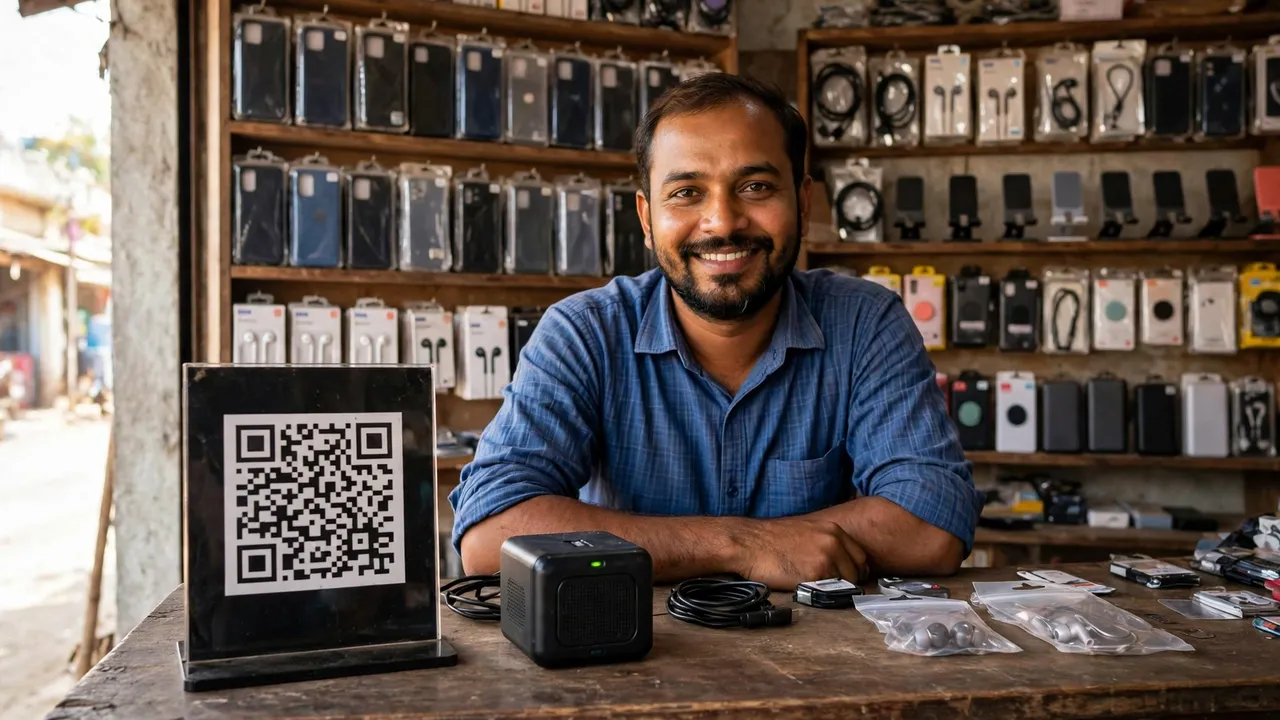
If you run a small shop in India — a kirana store, a tea stall, a vegetable cart, a tailor shop — a new scheme has your name written all over it. It is called the UPI Vyapaar Saksham Scheme, announced by NPCI on 11 November 2026, and it wants to put a free QR code and a free soundbox in your shop. This guide explains the whole scheme in plain words: who qualifies, what you get, what your shop must do every month, what UPI charges will look like, and when it all actually starts.
Read this carefully before you believe any message that promises you cash. The Rs 300 and Rs 750 figures in the headlines are real, but they are paid to your bank, not to you. Your benefit is different and, for a small shop, just as valuable: the tools to accept digital payments, free. Everything below comes from the NPCI circular of 11 November 2026 and the news reports that followed it, and every date is given as it stood on 14 November 2026.
What the scheme is — and why NPCI launched it
UPI is already the way most Indians pay at shops, but crores of tiny merchants still take only cash, or take UPI only sometimes. NPCI, the body that runs UPI, wants to close that gap. The UPI Vyapaar Saksham Scheme is its plan to do it: pay banks and payment companies to go out and onboard small merchants, one QR code at a time, with a target of up to 1 crore new QR codes every year.
The word Saksham means capable or empowered, and that is the idea — make the smallest shop capable of taking digital payments like a big store does. A QR code on the counter and a soundbox that speaks out each payment give a small shopkeeper the same confidence a supermarket has: every payment is seen, heard and recorded.
Who pays whom: the money twist explained
Here is the part most people get wrong. When the news says Rs 300 per QR code and Rs 750 per soundbox, that money goes to the bank or payment service provider that gives you the device — not into your pocket. Your gain is that the QR code and the soundbox cost you nothing. Think of it as the government paying the bank to serve you, instead of the bank charging you.
The fund for these incentives is 5 percent of UPI MDR, the fee charged on merchant UPI payments. It is divided into three parts. Part A, 30 percent, rewards banks for onboarding new merchants. Part B, 50 percent, rewards growth — 0.03 percent of the eligible UPI value, with 50 percent extra in the target towns and regions, provided usage grows at least 5 percent from one quarter to the next. Part C, 20 percent, rewards incremental growth — 0.20 percent of the rise in UPI value in target geographies. You do not need to memorise this split. What matters for you is simple: the bank earns only if your shop actually uses UPI, so the bank has a reason to help you use it well.
Who can get it: eligibility in plain words
The first test is size. Your business must have had an annual turnover of up to Rs 40 lakh in the previous financial year. That line is drawn to keep the scheme for genuinely small shops, not for large traders. If your turnover is within that limit, you clear the first gate.
The second test is place. The scheme focuses on Tier 3 to Tier 6 centres — smaller towns and rural areas — along with the North-East states, Jammu and Kashmir, and Ladakh. Big-city shops in Tier 1 and Tier 2 are not the priority. Two groups are named directly in the scheme: beneficiaries of PM SVANidhi, the loan scheme for street vendors, and PM Vishwakarma, the scheme for traditional artisans and craftspeople. If you belong to either group, you are squarely inside the scheme.
The usage test: 25 payments and Rs 5,000 every month
A free QR code that nobody uses helps nobody, so the scheme sets a usage test. Every quarter, your shop must record at least 25 eligible UPI transactions in at least 2 of the 3 months, and receive at least Rs 5,000 of UPI value in every month. Both conditions must hold at the same time.
Only payments of Rs 2,000 or less count as eligible transactions. Reversed, refunded or cancelled payments do not count. And splitting one bill into several small payments to push up the count — bill-splitting — is banned. Take a real example: a kirana shop where 40 customers pay by UPI in a month, mostly Rs 100 to Rs 600 each, adds up to about Rs 12,000 in the month. That shop passes both tests with room to spare. A shop with only 12 UPI payments a month fails, even if its turnover is tiny. The lesson is plain: use the QR code every day, for every small sale.
MDR: what merchants will pay, and what stays free
MDR, the merchant discount rate, is the fee on UPI payments received by merchants, and it is what funds this whole scheme. Under the plan, MDR is 0.4 percent on payments above Rs 2,000, capped at Rs 300 per transaction. Payments between two people stay free. Payments up to Rs 2,000 stay free. And small merchants who take up to Rs 1 lakh a month through a personal QR code pay zero.
For the typical small shop, that means daily business does not change: a customer paying Rs 200 for groceries costs you nothing in MDR. The fee touches only large single payments above Rs 2,000, and even then it is capped at Rs 300. This is why the 25-transaction test counts only payments of Rs 2,000 or less — the scheme is built around the small, everyday payments that are free.
When does it start, and how long will it run?
This is where honesty matters. As of 14 November 2026, no start date has been fixed. The first date discussed was 15 October 2026, but the launch was deferred past Diwali, and reports now point to a possible January 2027 start. Anyone who tells you a firm date today is guessing.
Once it begins, the scheme will run for 3 years from the date UPI MDR is implemented, and NPCI will review it every 6 months. That review cycle matters: the rules can be adjusted as the scheme learns what works. If you are a small shopkeeper, the sensible move is to build the habit now — 25 UPI payments and Rs 5,000 a month — so that the day the scheme goes live, your shop is already passing the test.
What to do now: a five-step checklist
First, if you do not have a UPI QR code, ask your bank for one — and ask whether it will be covered under the Vyapaar Saksham Scheme when it launches. Second, put the QR code where every customer can see it, and ask cash customers to try UPI. Third, count your UPI payments each month: aim for more than 25, and more than Rs 5,000 in value. Fourth, if you are a PM SVANidhi or PM Vishwakarma beneficiary, keep your scheme documents ready, because your group is named in the scheme. Fifth, check this page again when MDR goes live — that is the day the scheme truly begins, and the checker here will tell you where you stand.
And one warning that never changes: nobody from the scheme will ever call you asking for money, your UPI PIN, or an OTP to give you a QR code or a soundbox. The tools are free, the incentives go to the bank, and anything that asks you to pay for enrolment is not part of this scheme.