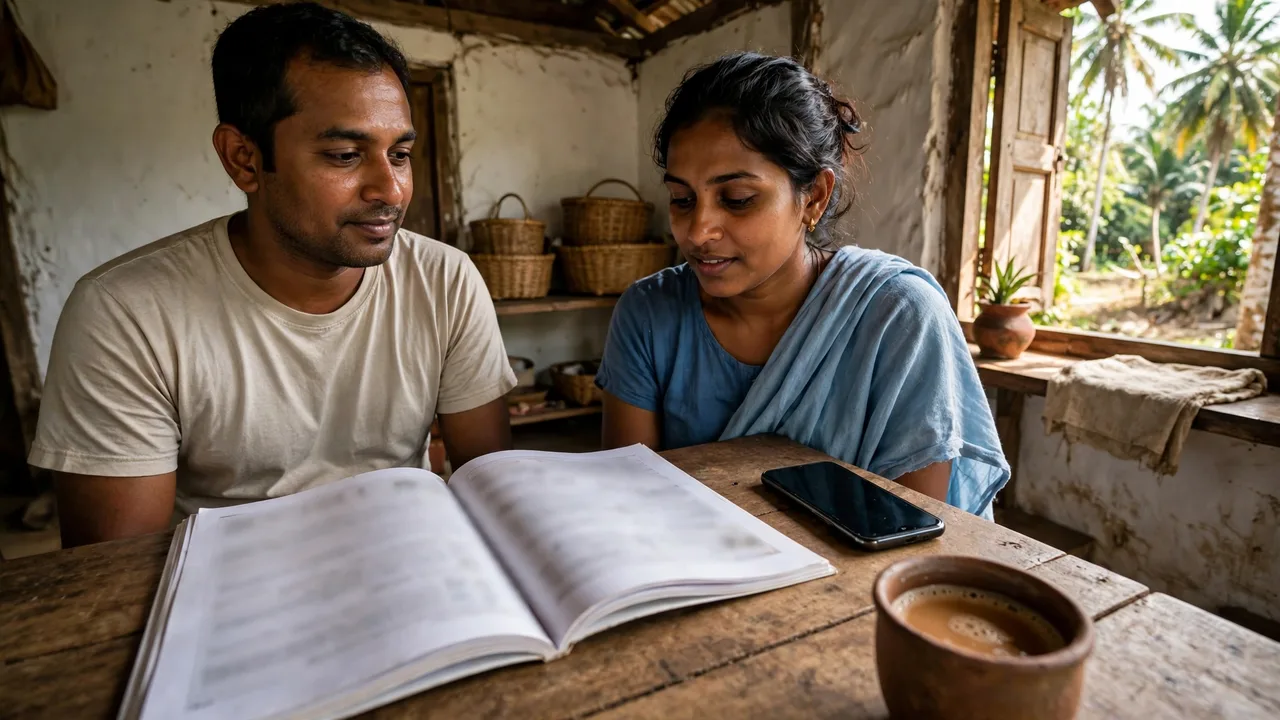
For example, Kamala checks her bank passbook the way other people check the weather. On the morning of 14 October 2026, the line she was waiting for appeared: the month's Aswesuma payment, credited straight into her account. For her family — a daughter in school, a husband whose three-wheeler work vanished in the hard years, and a mother of seventy-four living under the same roof — that credit is not pocket money. It is rice, medicine and bus fare, arriving in one line of print.
Families like Kamala's were among the 1,197,728 families paid in October 2026. Yet confusion is everywhere: which category am I in, why did my neighbour get more, why did a payment stop, is my name still on the list after re-verification? This guide answers those questions in the order families ask them, using only what the Board and the Cabinet have officially published.
31 October 2026: the first list is out
As of 31 October 2026, this guide is updated for the first re-verified list: on 28 October 2026 the Welfare Benefits Board published the first updated list, based on information updated to 27 October 2026. It covers 2,383,630 households: 991,800 are eligible — 363,142 Extremely Poor families at Rs 17,500 and 628,658 Poor families at Rs 10,000 — and 1,391,830 are not eligible on this list. The October payment credited on 14 October to 1,197,728 families is a different figure — that was the October payment to families already being paid — so do not mix the two numbers. No new general application round has been officially announced.
Appeals and objections on this first list run from 29 October to 15 November 2026 — the Board extended the window from 11 November on 11 November, and from 12 November filings are online only — that window is for this list, and no separate appeal window for the second list has been announced yet. Letters to open an Aswesuma bank account go out from 12 November 2026, and the first payment to newly eligible families on this list is due on 27 November 2026, into an Aswesuma bank account only. For families already being paid, the monthly rhythm is unchanged: the Board announces each month's credit date when the payment is ready, never in advance.
What is Aswesuma, in plain words?
Aswesuma is Sri Lanka's main cash-support programme for families in hardship. It began on 1 July 2023, replacing the old Samurdhi scheme, and it is run by the Welfare Benefits Board under the Welfare Benefits Act No. 24 of 2002. Instead of coupons or goods, the money is paid monthly, directly into the beneficiary's own bank account.
The idea behind the change was targeting. Samurdhi lists had grown old and uneven; Aswesuma rebuilt the list from household data, ranking families by measured hardship rather than by old registers. The re-verification under way in 2026 is that same rebuilding, done again with fresher information.
How much does Aswesuma pay in 2026?
Since January 2025, two categories are paid. A family classed as Extremely Poor receives Rs 17,500 a month; a family classed as Poor receives Rs 10,000 a month. These figures come from a Cabinet decision of 2 December 2024, which raised the original 2023 rates of Rs 15,000 and Rs 8,500.
On top of the category amount, extra monthly allowances are paid for qualifying members (Cabinet decision of 17 March 2025): Rs 5,000 for each member aged 70 or older, Rs 10,000 for each member with a disability, Rs 10,000 for each kidney (CKD) patient and Rs 10,000 for each CKDu patient. So an Extremely Poor family with a grandmother over 70 receives Rs 22,500 a month in total. The member must be registered for that allowance — an unregistered grandmother is money quietly left unclaimed.
How are families chosen? The 22 criteria
Selection is not done by a local official's opinion. The Department of Census and Statistics computes a Multi-Dimensional Deprivation Score for each household from 22 published criteria in six areas: education (including children aged 5 to 16 who are not in school), health (chronic illness and disability), economic life (income and spending per person, electricity use under 60 units), assets (land, vehicles, equipment, livestock), housing (walls, floor area, water, sanitation, electricity) and family make-up (how many depend on each earner, single-parent homes), matched against district quotas.
Here is the honest limit: the list of 22 criteria is public, but the weight each carries in the score is not. No website, agent or officer can truthfully promise you a category in advance. The eligibility checker linked below this guide counts how many criteria your family matches — a real, useful measure — and sends you to the official list, where the actual decision lives.
How to check your name on the list
There is no single national PDF with everyone's name. The list lives in the government's IWMS Social Register, and you reach it four ways: browse the List of Eligible Families by Province, District, Divisional Secretariat Division and Grama Niladhari Division; search by NIC or Household Reference Number; open your household record, which shows your selected category, payment status and the bank details on file; or use the Phase II lists on WBB eServices. Printed lists are also displayed at Divisional Secretariat and Grama Niladhari offices.
Notice what you never have to do: hand your NIC number to a stranger's website. The search happens on the government's own pages. Any site asking you to type your NIC into its own form — or charging a fee to check — is not the register.
Name missing? The appeal — you get one chance
If your name is not on the list and you believe your family's situation qualifies, you can appeal. Appeals and objections are filed online through WBB eServices, on printed forms available in the downloads section of the Board's website, or in person at your Divisional Secretariat office. Appeals use Forms A and B; an objection uses Form C — fill in every section, because a half-empty submission risks rejection. Officers at the Divisional Secretariat's Welfare Benefits Unit can help you submit online. Phase II families — those missed in the first census — have had their own list rounds in 2026, each with a fresh window to object.
One rule deserves your full attention: each applicant gets only one appeal. A hurried, half-empty appeal wastes the single chance you have. Before filing, re-check your household record for errors — wrong income details, a missing disabled member, an old address — and correct them in the appeal itself. A member of the public objecting to someone else's inclusion may object anonymously — that is different from your own appeal. And do not send an appeal by post, email or phone to the head office: the head office does not accept them that way. The 1924 hotline is for help and questions, not for filing.
What changed in 2026 — and what has not been announced
The biggest change is subtraction. The Vulnerable category, which paid Rs 5,000 to about 425,000 households, was discontinued in June 2026, and the Transitional category has closed. Re-verification has now produced its first list: on 28 October 2026 the Board published 991,800 eligible families, with 1,391,830 not eligible on this list. A second list is expected in December 2026, based on a further 740,127 families whose information was updated — that is the number updated, not the number who will qualify, and no exact December day or qualifying count has been announced. The government says the two surviving categories are planned to continue until June 2027 — a plan, not a promise.
And a warning against the rumour mill: despite heavy searching online for an 'Aswesuma application 2026', no new general application round has been officially announced. When one opens, it will be announced on wbb.gov.lk first. Anyone selling early registration today is selling fiction.
The 5-step payment check
One, open your household record on the IWMS register: check your selected category, your payable status and the bank account on file. Two, check allowance registration: an elderly, disabled or kidney-patient member must be registered for that allowance, or the extra money is never added. Three, when searching for a name, check spelling differences, old boundaries and the Phase II lists — the name may be there.
Four, appeal only to correct facts, remembering you get one appeal, and bring documents. Five, ask questions at your Divisional Secretariat office, your Grama Niladhari, or the Board hotline 1924. Never hand your NIC number to a stranger website, and never pay anyone for a check or a registration. If you are newly eligible on the first list, keep this separate from the monthly check above: your bank-account letter comes from 12 November 2026 and your first payment is due on 27 November 2026, into an Aswesuma bank account only.