
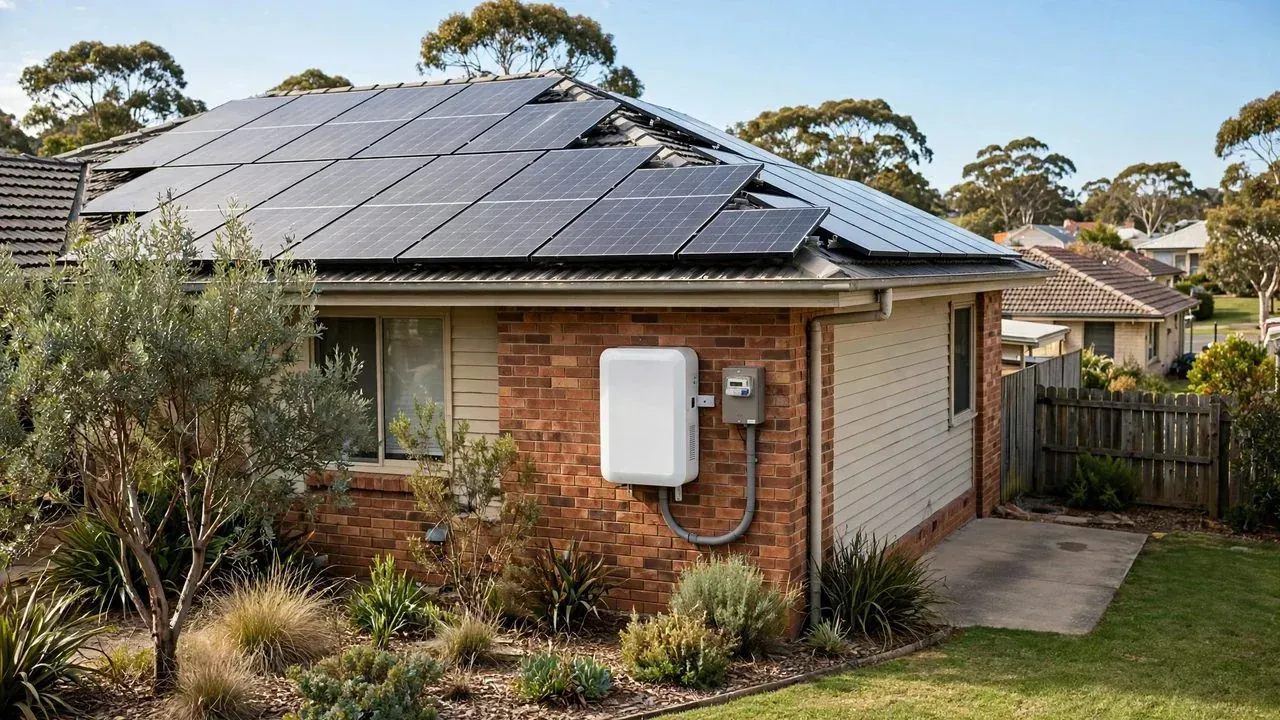
Dave Whitford, 52, drives trains for Queensland Rail and lives in Logan City, south of Brisbane, where the sun does most of the heavy lifting eleven months a year. He put 6.6 kilowatts of solar on his roof back in 2022, and it's been brilliant — except at night, when his air-con runs on grid power at peak prices while his panels sit idle in the dark. For a year now he's been circling the idea of a battery.
Last month Dave finally did the maths — and found a clock ticking inside it. The federal Cheaper Home Batteries rebate is generous today, but on January 1, 2027, it drops by about 16%. For the 13 kWh battery he's looking at, waiting past that date costs roughly $529. That's real money for doing nothing but waiting. Here's how the tiered rebate works, what the January step-down takes away, and how to decide whether beating the clock makes sense for you.
How the rebate is actually calculated
The discount comes as STCs — small-scale technology certificates — currently worth 6.8 per usable kWh, which works out to about $252 for every kilowatt-hour. But it's tiered: the full rate covers only the first 14 kWh, then drops to 60% on the next 14 kWh, and just 15% beyond that, up to 50 kWh.
So Dave's 13 kWh battery — sitting entirely inside the top tier — gets roughly $3,276 off, straight off the install invoice. A 30 kWh system pushes deep into the lower bands, where each extra kWh earns far less. You never touch a certificate yourself: your installer claims the STCs and takes them off your bill.
What happens on January 1
From January 1, 2027, the factor falls to 5.7 STCs per kWh — about $211 per kWh instead of $252. That same 13 kWh battery would then attract roughly $2,747: $529 less than today, for the exact same hardware.
And this isn't a one-off: the rebate keeps stepping down every six months through 2030. Earlier is always cheaper — with one big caveat. Installer calendars are already filling for December, and a rushed, shoddy installation wipes out the savings. Only beat the clock if the install is done properly by an accredited installer.
The eligibility checklist
The battery must be 5–100 kWh nominal, paired with new or existing solar, a CEC-approved product, and fitted by an SAA-accredited installer. If it's on-grid, it must be VPP-capable — actually joining a virtual power plant is optional, but the capability is mandatory.
It's one rebate per premises, there's no income test, and it stacks with state top-ups — so check what's on offer in Queensland too. The rebate calculator at the top of this page shows your before-and-after-January figures side by side.
Should you rush?
If you were already considering a battery, the $500-ish saving is genuinely real. But don't sign with a dodgy installer just to beat the clock. Dave's rule: get 2–3 quotes from accredited installers and confirm a pre-January install date in writing before committing a cent.
And watch the door-knockers. Every rebate deadline brings out salespeople pitching 'free batteries' and 'today-only government deals' — the federal rebate is a fixed discount, not a limited-time offer, and no legitimate installer needs your signature on the doorstep. Official program details are at dcceew.gov.au; we're an independent guide, and we'd rather you wait than get ripped off.
One more piece of Dave's homework: sizing. A 13 kWh battery covers the evening peak for most four-person households with 6–7 kW of solar — it stores the afternoon surplus and runs the house until bedtime. Oversizing into the lower rebate tiers rarely pays: the extra kilowatt-hours earn the rebate at just 15%, while still costing full price. Match the battery to your evening usage, not your roof size.
The December rush — what Dave learned calling installers
Dave rang three accredited installers in a week. The first couldn't fit him in until February — past the deadline. The second could do mid-December but wanted a deposit that day, on the phone, with no written quote. The third — the one he went with — sent a proper written quote, confirmed a December install date in writing, and explained the STC discount line by line.
That's the December reality: good installers are booking out, and the pressure creates perfect conditions for cowboys. Dave's rules, borrowed from a mate who installs solar for a living: never pay a same-day phone deposit, always get the install date in writing, and check the installer's SAA accreditation yourself — it takes two minutes online.
The $529 saving is real, but it's only a saving if the job is done right. A badly installed battery that voids its warranty is the most expensive battery of all.